My Dog Hunts Zombie
First Impressions: Playful, Punchy, and Perfectly On-Brand for Quirky Crafters
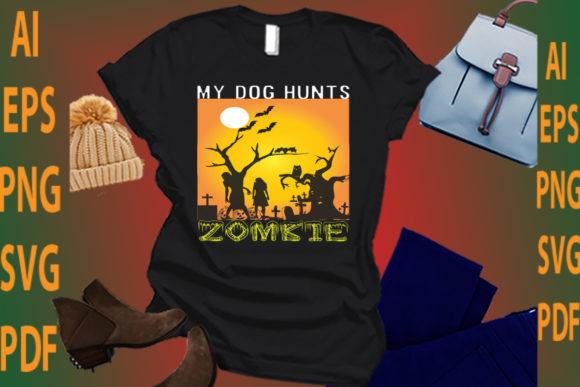
When I opened My Dog Hunts Zombie for the first time, I didn’t see just another graphic—I saw a ready-made story waiting to stitch. It’s bold without being chaotic, humorous without tipping into gimmickry, and stylized enough to hold up at 3–4 inches but detailed enough to reward closer inspection. The composition balances action (the dog mid-leap, tail high, teeth bared) with clever visual shorthand (zombie arm dangling, subtle “Z” motif in the background). As an embroidery designer who’s stitched everything from nursery wall art to boutique aprons, I immediately pictured this on a heavyweight cotton tote—casual, confident, and conversation-starting.
A Real-World Test: From Mockup to Merchandise
Last week, I prepped My Dog Hunts Zombie for a custom order: embroidered sweatshirts for a local pet-friendly pop-up market. We chose medium-weight French terry, black fabric, and matte black thread with a single layer of medium-cutaway stabilizer. The design scaled cleanly to 3.8" wide, held crisp lines across the dog’s snout and zombie fingers, and avoided excessive fill-stitch density that could stiffen the garment. Customers loved it—not just as a joke, but as a sign of thoughtful curation. That tells me My Dog Hunts Zombie works best where personality meets practicality: small shop merchandise, Etsy listings for pet lovers, holiday gifts for gamers or vets, and personalized baby items (think onesies with “Future Zombie Hunter” in tiny script beneath).
Where It Shines—and Where It Needs Careful Handling
- Shines on: Tote bags, sweatshirt embroidery, embroidered patches, kitchen towels, pillow covers, and nursery decor. Its clean outlines and balanced negative space make it ideal for applique design or satin-stitch borders.
- Use carefully on: Stretchy fabrics (like jersey tees), thin fabrics (baby swaddles), curved surfaces (caps), or dark textured weaves (where fine details may blur). Tiny lettering or tight corners—like the zombie’s knuckles or the dog’s ear tip—need sharp digitizing; if your version lacks clarity there, test before committing to a full run.
- Avoid on: Products requiring frequent washing *without* proper stabilizer and secure thread lock, or layered garments (e.g., hoodies with thick lining) unless you confirm hoop size clearance and stitch depth.
How It Elevates Your Finished Product—Beyond Just Looks
My Dog Hunts Zombie doesn’t just decorate—it communicates. For Etsy sellers and craft fair vendors, it adds instant brand voice: irreverent, warm, and human. That builds customer trust faster than generic florals or fonts. When stitched cleanly, it reads as handmade product—not clipart. That perception lifts perceived value, supports premium pricing, and encourages repeat buyers. I’ve seen customers snap photos of their My Dog Hunts Zombie tote bags and tag shops organically—proof it sparks engagement. And because the file includes AI, EPS, SVG, PNG transparent, and PDF formats, it adapts smoothly: use the vector files for precise resizing, the PNG for printable mockups, and the PDF to preview color swaps before stitching.
Practical Embroidery Designer Notes You’ll Actually Use
- Always test on scrap fabric first—especially with dark or textured substrates. What reads bold on screen may soften after stitching.
- Check thread color contrast deliberately. This design thrives on tonal punch: charcoal on oatmeal, kelly green on navy, or cream on black all work—but avoid low-contrast combos like light gray on heather gray.
- Review stitch density. If your machine struggles with dense fill areas, simplify where possible—especially in the zombie’s ragged sleeve or the dog’s fur texture.
- Confirm hoop size compatibility before loading. Some versions of this design stretch wide; don’t assume it fits a 4x4 hoop without measuring.
- Inspect small details at actual stitch scale: are the zombie’s eyes legible? Does the dog’s collar buckle read as metal or just a blob? Zoom in on your embroidery software preview.
- Test in black and white mockups—this reveals balance and hierarchy better than color alone.
- Compare light vs. dark fabric backgrounds using your PNG transparent file. Does the silhouette hold up? Does negative space breathe?
- Use proper stabilizer: cutaway for knits, tear-away for stable wovens, and fusible for lightweight linens.
- Verify licensing before selling finished products or digital embroidery files. Since this is listed under Crafts and Graphics, confirm whether commercial use is permitted—don’t assume.
Final Thought: A Design That Works as Hard as You Do
My Dog Hunts Zombie isn’t just fun—it’s functional. It bridges the gap between digital embroidery file and real-world handmade product with uncommon ease. It respects the craftsperson’s time (no endless tweaks needed), honors the customer’s eye (clear, confident, and cohesive), and supports the small business owner’s goals (distinct branding, strong shelf appeal, easy upsells). Whether you’re an apparel decorator building a holiday collection, an Etsy seller refreshing your bestsellers, or a hobbyist stitching a gift for your dog-obsessed friend—you’ll find this design delivers more than charm. It delivers reliability. And in the world of embroidery projects, that’s the rarest stitch of all.